Five short-term rentals in Tokyo that trade the hotel formula for something more considered.
Tokyo has no shortage of places to sleep. What it does have, if you know where to look, is a small but distinct category of short-term stays that go beyond the standard hotel formula: apartments with actual design intent, buildings with histories worth knowing, neighborhoods that reward the kind of traveler who'd rather feel at home than serviced. The five listings below sit in that category. From a concrete loft in Hiroo to a living artwork in Mitaka, each one offers something a hotel room, by definition, cannot.
Tokyo Greenhouse Loft
Location: Seijo, Setagaya City
Capacity: 4 guests maximum, 2 beds / 1 bath
Great for: Couples, small families
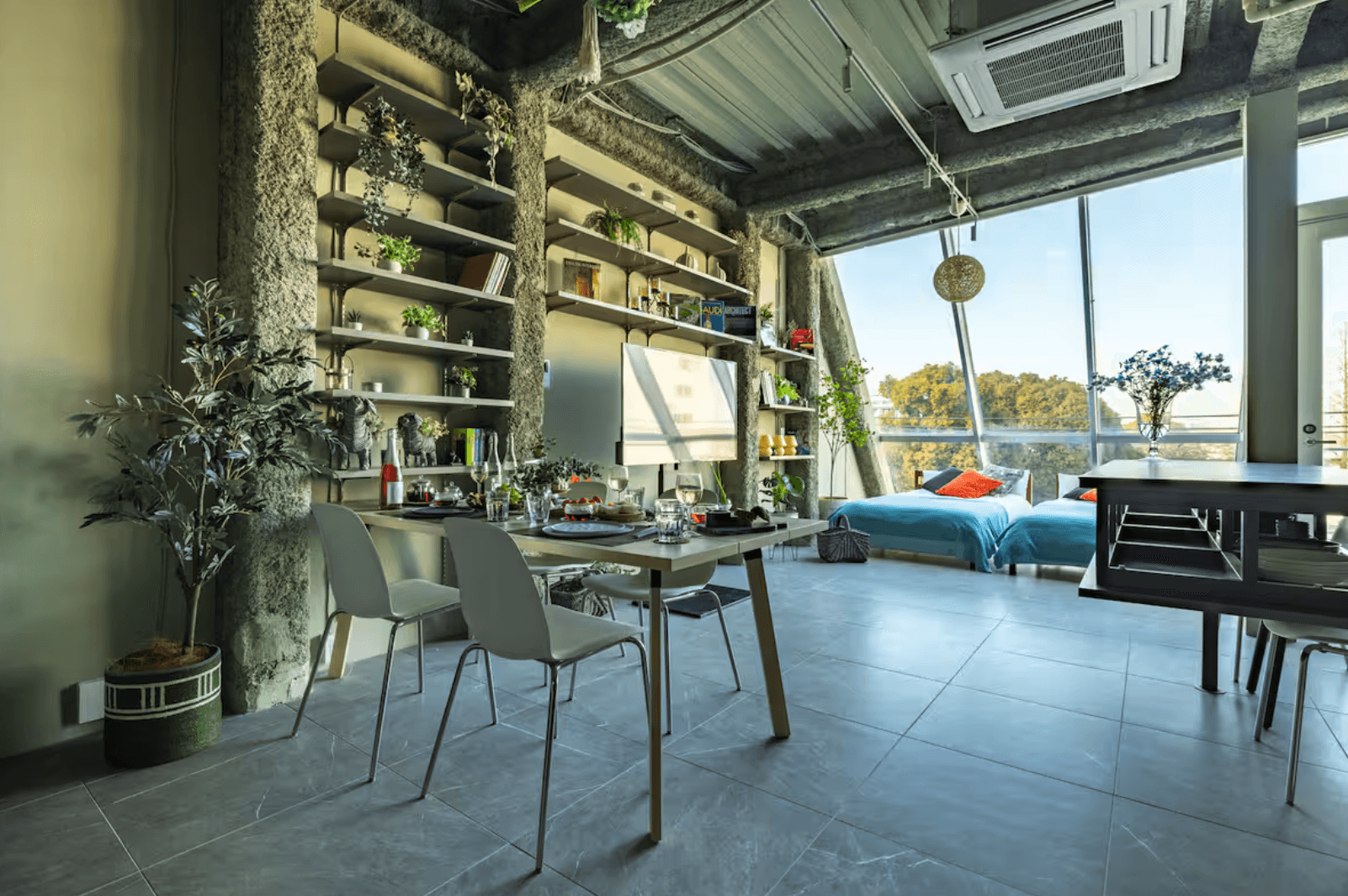
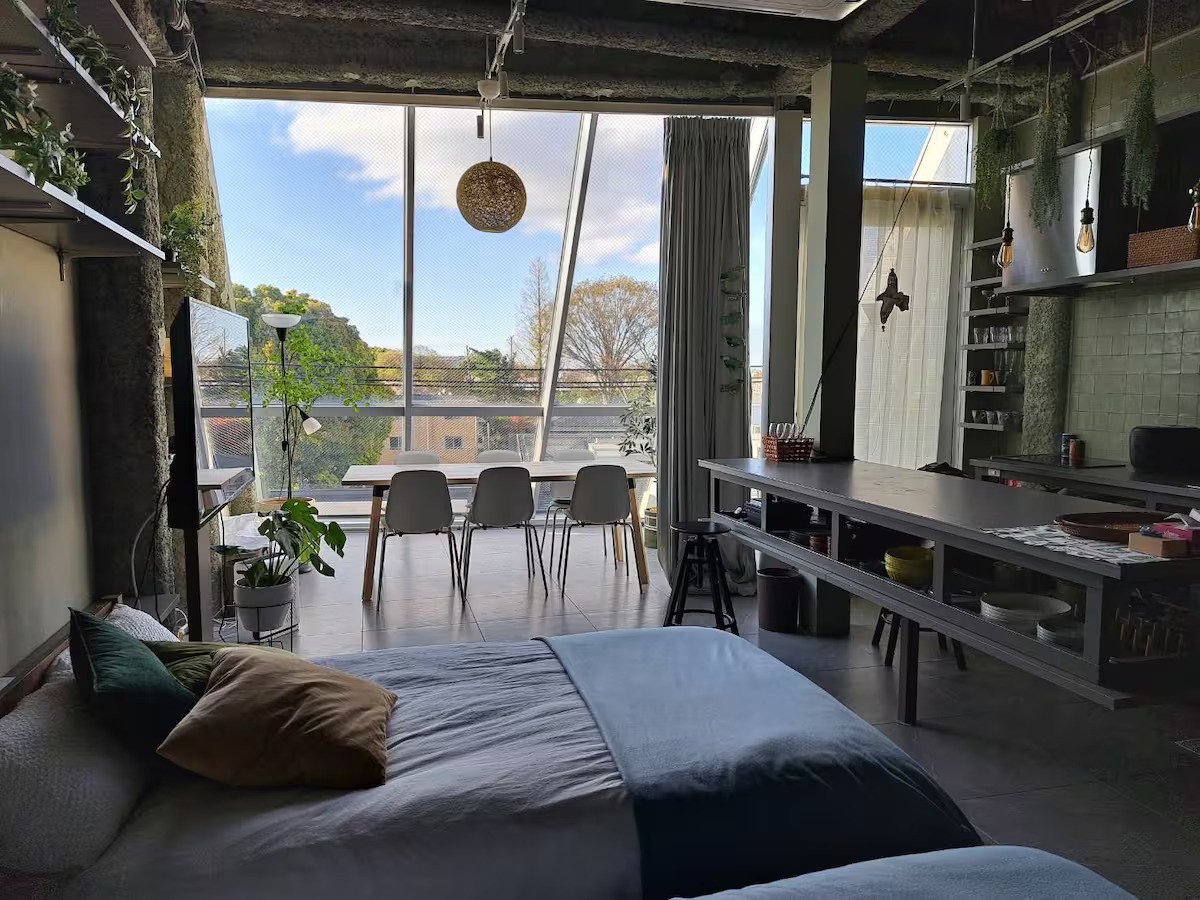
Set in Seijo, Setagaya, this Airbnb puts you in one of Tokyo’s quieter, more polished residential neighborhoods — an area sometimes described as the “Beverly Hills of Tokyo.” It is not the obvious first-time Tokyo base, which is part of the appeal. Instead of the constant bustle of Shinjuku or Shibuya, Seijo offers a quieter version of the city: upscale boutiques, low-key restaurants, neighborhood cafés, and the kind of everyday convenience that makes a longer stay feel homey.
The apartment is just a short walk from Seijogakuen-mae Station, with direct access to major hubs like Shinjuku and Shibuya in around 15 to 20 minutes. For day-to-day essentials, there are convenience stores at the base of the building, plus supermarkets nearby — especially useful given that the unit comes with a proper kitchen.
Inside, the space has a classic loft-studio feel: large windows, concrete beams, exposed ceilings, and an open layout that feels purposefully curated. The kitchen is equipped with the essentials — cookware, utensils, and small appliances — making it easy to handle simple meals between days out in the city. Plus, the in-unit washer/dryer is a useful bonus for anyone packing light or staying more than a few days.
Work & Gym Loft
Location: Hiroo, Shibuya
Capacity: 4 guests maximum, 3 beds / 1 bath
Great for: Couples, remote workers
This concrete loft sits between Hiroo and Ebisu, two of Tokyo’s most quietly desirable central neighborhoods. The location is the kind that frequent Tokyo visitors learn to seek out: close enough to Shibuya, Roppongi, and the rest of central Tokyo that nothing feels inconvenient, but residential enough that coming home at the end of the day actually feels like coming home. Cafés, restaurants, supermarkets, and convenience stores are all within a short walk.
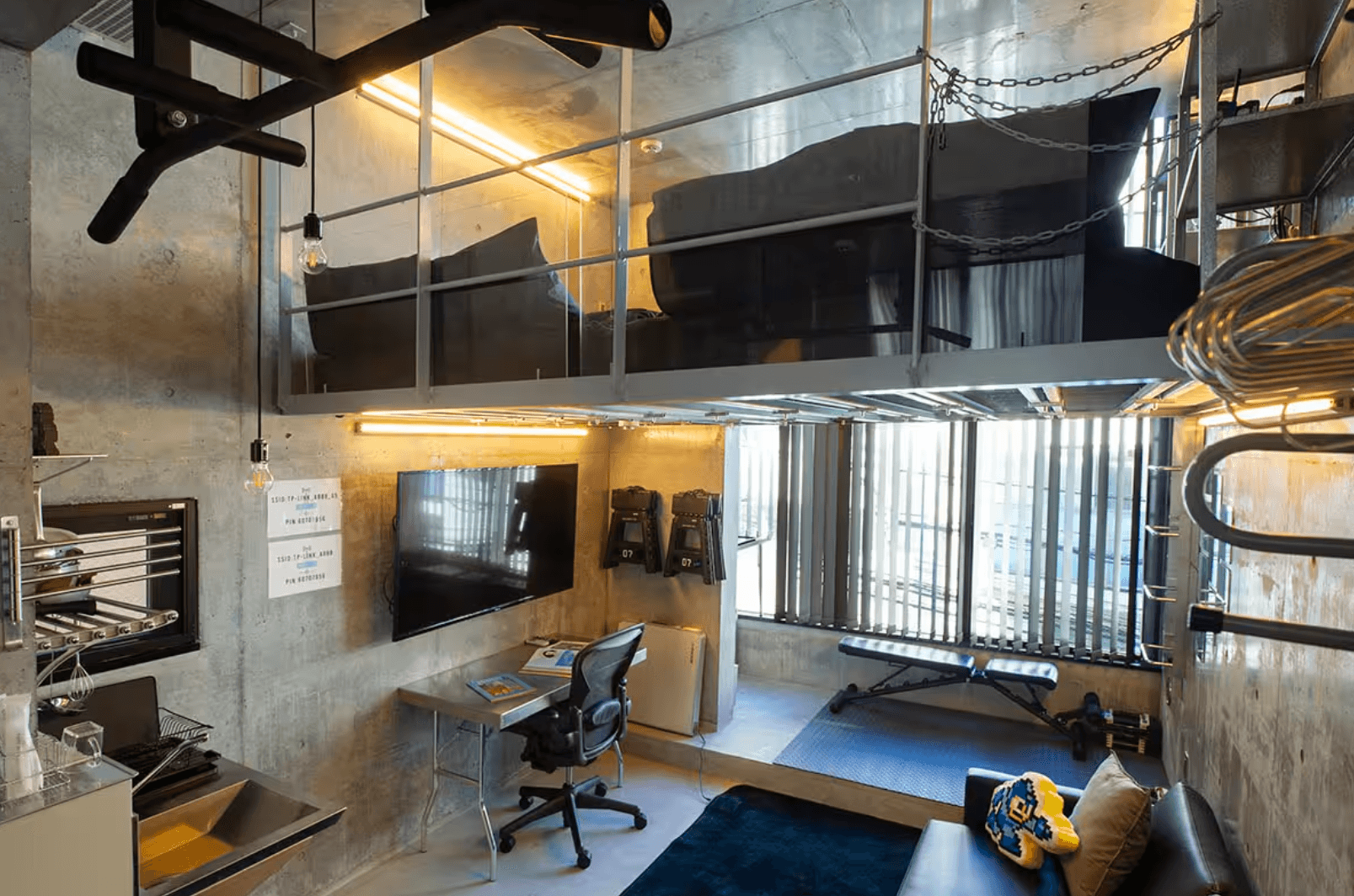
The unit itself is compact, but it's been thought through. Raw concrete walls, warm tube lights, stainless steel fixtures, and a raised sleeping area give it an architectural quality that sits closer to a designer micro-apartment than a standard rental. It's a small city nook in the best sense.
Where it really distinguishes itself is as a base for remote workers or longer stays. The setup is work-ready: fiber internet, a Herman Miller Aeron, a 55-inch Chromecast display, a Bose speaker system, and a ring light for calls or content work.
Practical details round it out well: the kitchen covers the basics for simple meals, there's a workout bench, free weights, and a pull-up bar for anyone who wants to keep a routine, and a coin laundromat is down the block. For travelers who want genuine Tokyo convenience without the chaos of staying in the middle of it, this one is hard to argue with.
Reversible Destiny Lofts
Location: Mitaka, Tokyo
Capacity: 2 guests, 2 bed / 1 bath
Great for: Couples, art and design buffs
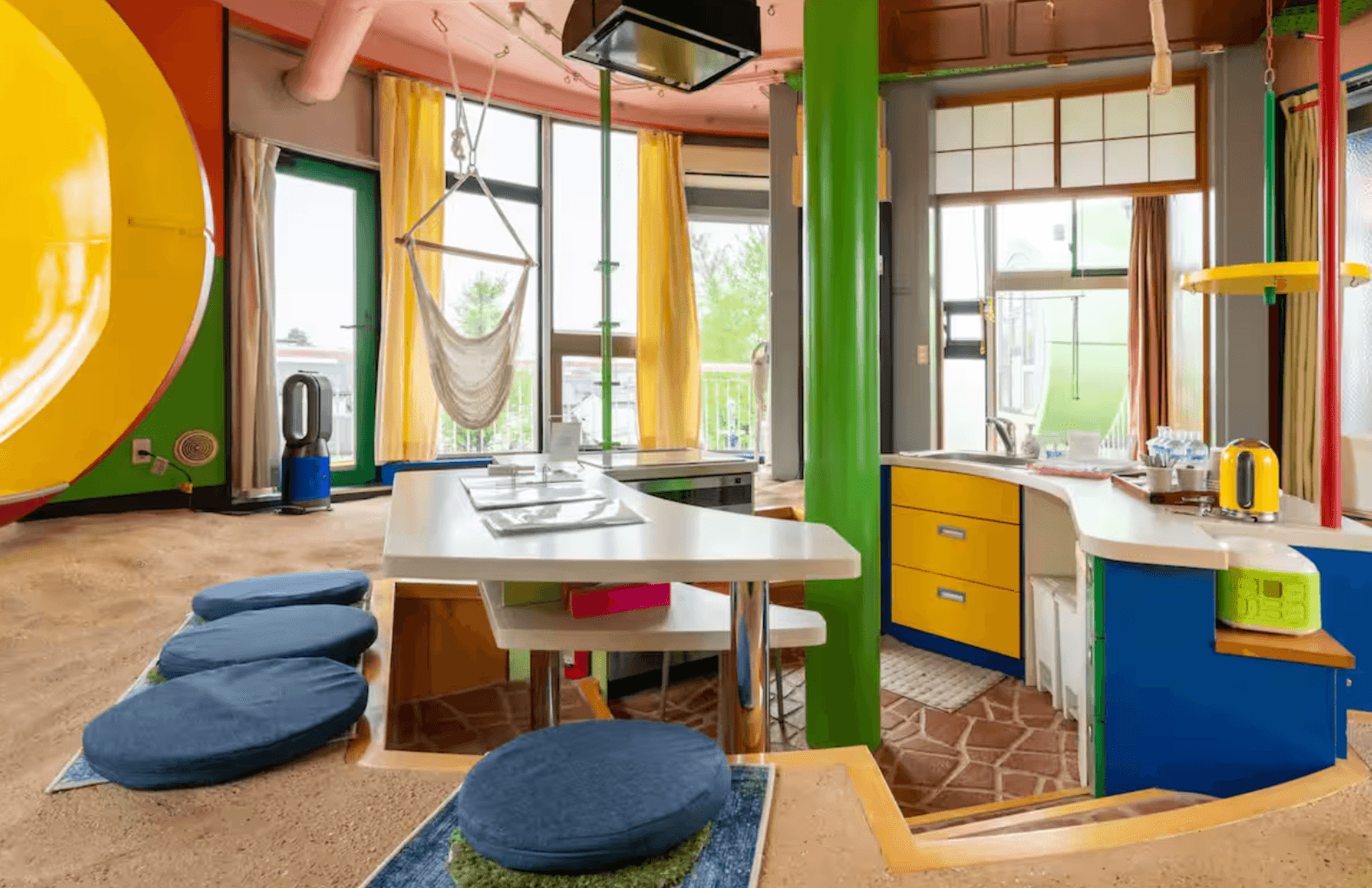
The Reversible Destiny Lofts in Mitaka were completed in 2005 by artist-architects Shusaku Arakawa and Madeline Gins, and the concept behind them is as unusual as the spaces themselves. Built around a philosophy they called "procedural architecture," the nine-unit complex was designed to keep its residents perpetually alert: uneven floors, poles for navigation, ceiling hooks in place of conventional storage, rooms built from spheres and tubes rather than right angles, and light switches placed at irregular heights so you never slip into autopilot.
The unit available here sits at around 52 square meters and is built for two. There's a bedroom, a study, a kitchen, a bathroom, and a balcony — all arranged around a circular central room with an uneven compacted floor. The whole complex is painted in fourteen colors, which also extends to the interior: this is not a neutral space.
Practically speaking, it's well-equipped. WiFi, a washing machine, air conditioning, a full kitchen setup, and a hammock are all included. The location in Mitaka, in Tokyo's western suburbs, is quieter and more residential than the central wards, but the Chuo Line connects you to Shinjuku in about 15 minutes. Mitaka also happens to be home to the highly popular Ghibli museum.
Our honest caveat is that this is not a place to decompress in the conventional sense. The architecture is confrontational, and that's the point. But for the right kind of traveler — one who wants to stay inside a work of art — there isn't much else like it.
Shibuya Luxury Villa
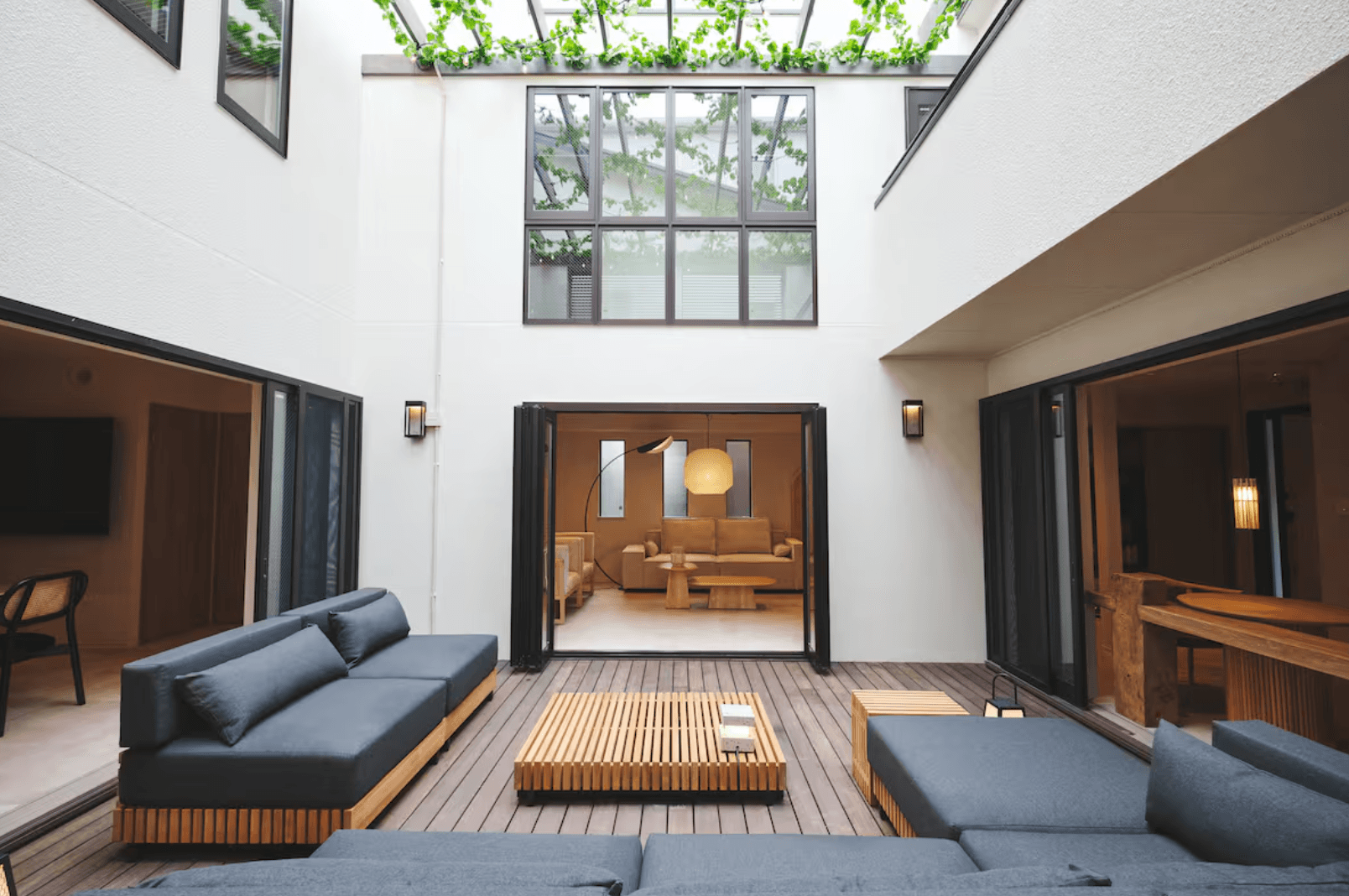
Location: Honmachi, Shibuya
Capacity: 15+ guests, 6 beds / 2.5 baths
Great for: Large groups, trips with family and friends
Finding a whole house in central Tokyo that can sleep a large group is harder than it sounds. Most options either sacrifice location or feel like an oversized business hotel. This one sits in Honmachi, Shibuya, and feels more like a proper Japanese home than a short-term rental conversion.
The property spans three floors and 245 square meters, with six bedrooms, eleven double beds, a ground-floor patio, and a rooftop terrace. The interior leans into a refined, natural finish: wood, clean lines, two distinct living areas, one indoors and one opening to the patio.
For a group stay, the practical setup holds up well. The kitchen is fully equipped for actual cooking, there are three bathrooms, a washer-dryer, ReFa hair dryers, and a 75-inch TV alongside a wall-mounted projector in the common areas. A note on layout: the first-floor bedroom is open to the dining area with no door, and two of the upstairs bedrooms require passing through another room to access. Worth knowing in advance depending on your group's privacy needs.
The location is the other strong argument here. Hatsudai Station is a six-minute walk, and from there it's one stop to Shinjuku. Shibuya is about ten minutes by car. The surrounding streets are quiet and residential, which is a rarer thing to say about a house this close to two of Tokyo's busiest hubs.
For groups traveling together — families, friend trips, creative retreats — this covers the bases without feeling like a compromise.
Japandi Design House Above a Cafe
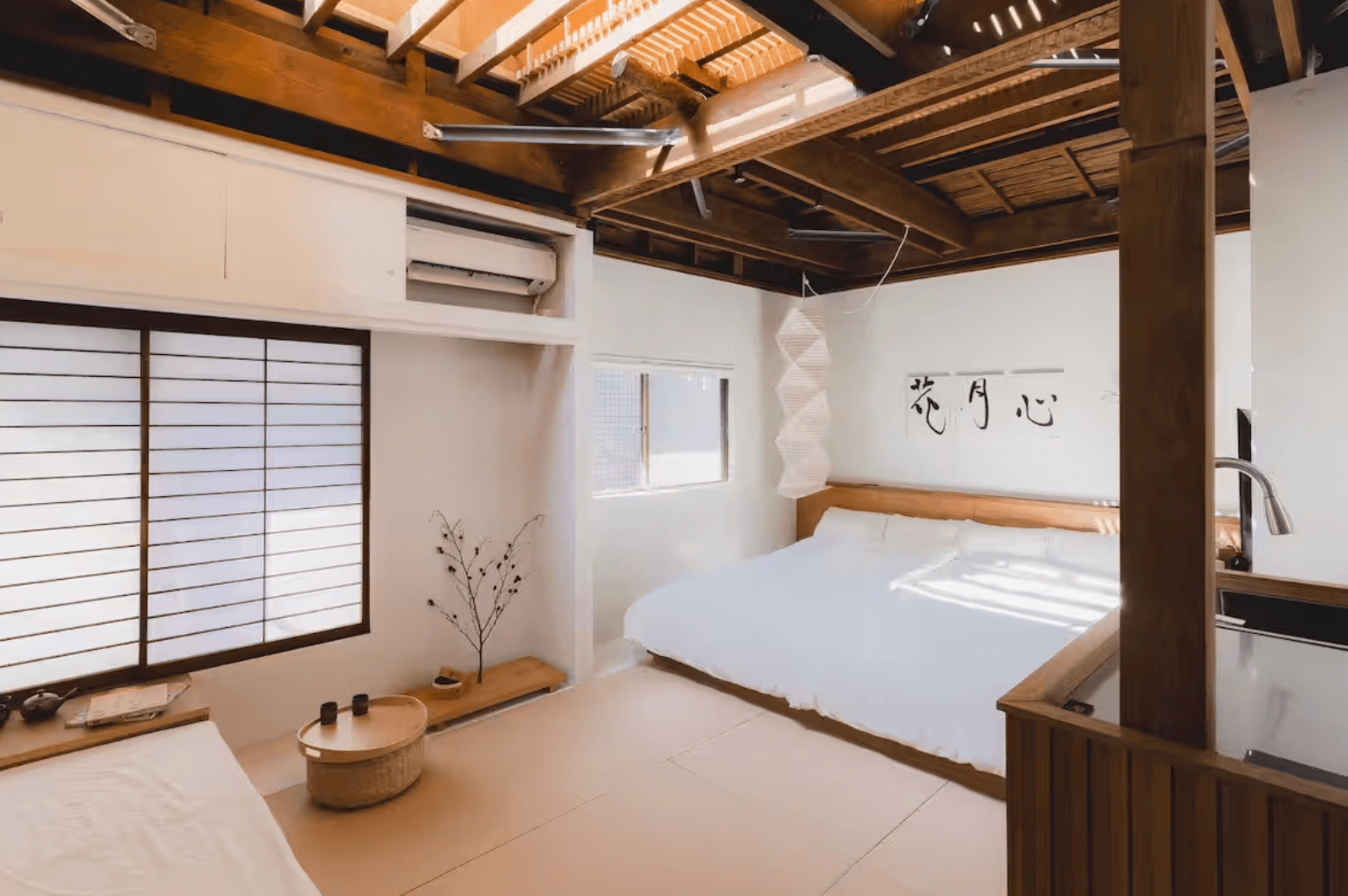
Location: Sangenjaya, Setagaya City
Capacity: 4 guests, 2 beds / 1 bath
Great for: Couples, design buffs, small families
Set in Sangenjaya, Setagaya, this stay puts you in one of Tokyo's most quietly compelling neighborhoods. Sangenjaya has a long-standing reputation as a local's neighborhood — dense with independent cafés, izakayas, vintage shops, and a general lack of tourist infrastructure, which at this point is its own kind of draw.
The guest space occupies the second floor, a Japandi-styled room with a king bed, a sofa bed, a small loft accessible by ladder, a mini kitchen, and a private shower and toilet. The host is an architect who designed and built the space themselves, and it shows: exposed ceiling elements, beautiful wood details, and plenty of natural light deliver a relaxing and comfortable aesthetic for stays of any duration.
The ground floor houses the host's café, RECEPTION, which is open daily except Tuesdays. Each stay includes a complimentary breakfast plate, redeemable during café hours. After closing, the lobby seating area stays open with books and magazines. Coming down the stairs to a well-designed café before stepping out into one of Tokyo's best neighborhood streets is a rare combination that RECEPTION was designed to deliver.
